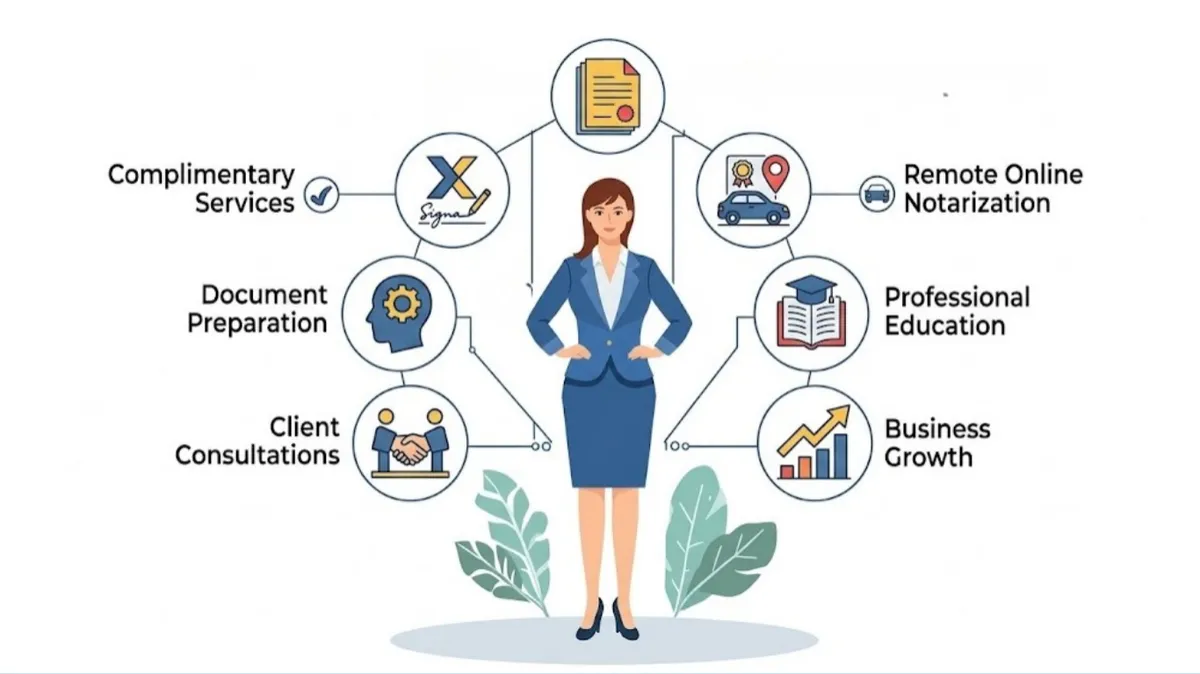
How to Expand Your Notary Business Beyond Notarizations
How to Expand Your Notary Business Beyond Notarizations
When you first become a notary, you may have a very simple goal.
Maybe you want to work from home. Maybe you want more control over your schedule. Or maybe you want to build something of your own.
But as you gain experience, you may start seeing opportunities you didn't even know existed when you received your commission.
I recently caught up with Destinee Irons, a Remote Online Notary based in Las Vegas, Nevada, who has been on the channel before. Since our previous conversation, her business has gone through both challenges and significant changes.
After a difficult period in 2024 and into 2025, Destinee described 2026 as a rebuilding year. She has returned to marketing, attending events, making new connections, and reminding businesses that she's available for Remote Online Notarization services.
But she's also entering a completely new chapter.
Destinee is expanding into document preparation and estate planning-related services within the scope of her Nevada registration.
Her journey is a great example of how a notary business can evolve, but also why expansion should start with a strong foundation.
Your Business Can Slow Down and Grow Again
One thing I appreciated about Destinee's update was her willingness to talk about a period when business wasn't growing.
She has been a Remote Online Notary since 2022, but personal circumstances significantly affected her business in 2024 and 2025.
Instead of treating that slowdown as the end of the business, she adjusted.
As her circumstances changed, she started rebuilding.
That meant getting back into marketing, attending events, reconnecting with people, and putting herself in front of potential clients again. Gradually, new connections and opportunities started coming into her business.
Entrepreneurship isn't always a straight line.
One benefit of building your own service business is that there may be seasons when you push harder and seasons when you need to slow down. What matters is recognizing that a slower season doesn't necessarily mean you can't build momentum again.
From Notary Work to Document Preparation
Destinee's newest expansion is into document preparation.
She has been registered as a document preparation professional in Nevada for approximately two years, but she hadn't fully launched that part of her business.
Now she's actively developing it.
She shared that she is beginning with her first estate planning client and has been studying areas involving trusts, wills, powers of attorney, and other documents relevant to the services she wants to provide.
This is an important place to make a distinction.
Document preparation requirements vary by state, and Destinee specifically explained that not every notary can simply begin offering these services. Her ability to provide document preparation services is tied to her registration in Nevada.
A notary commission by itself does not automatically authorize someone to prepare legal documents or provide legal advice.
If you're interested in expanding into document preparation or another adjacent service, research the laws, registration requirements, licensing rules, and limitations that apply where you operate before offering it to clients.
Can Document Preparation Be a Remote Service?
One reason Destinee initially entered the notary industry was because she wanted to work from home.
Document preparation may still give her some of that flexibility.
She explained that she can perform aspects of her document preparation work virtually, using phone calls or online meetings with clients.
At the same time, she's considering whether an office might eventually make sense for the estate planning side of her business.
Her reasoning is that these client interactions may feel different from a relatively short RON appointment. Some people may prefer sitting down in person when discussing their estate planning needs.
For now, she sees flexibility in the model.
Depending on the client and situation, she may work virtually, meet by phone, or travel to a local client.
That flexibility is one of the reasons a service-based business can evolve in so many different directions.
Destinee Didn't Plan to Build This Kind of Business
When Destinee first became a notary, she wasn't thinking about building a business with multiple services.
Her original goal was straightforward.
She wanted to notarize documents, work from home, be her own boss, and create her own schedule.
But the longer she spent in the industry, the more possibilities she discovered.
You start meeting other notaries.
You learn what services they're offering.
You discover niches you didn't know existed.
One person might offer fingerprinting. Another might specialize in apostille-related services. Someone else might work heavily with deeds or Remote Online Notarization.
That exposure can completely change how you think about your own business.
For Destinee, growth happened in stages. She learned mobile notary work, then RON, explored additional services, and is now developing the document preparation side of her business.
You don't necessarily need to know what your business will look like five years from now when you're just getting started.
You can build one layer at a time.
Become a Good Notary Before Adding More Services
This may be the most important takeaway from Destinee's interview.
Before trying to add every possible service to your business, become a really good notary.
Destinee emphasized that your foundation comes first.
Know the laws that apply to you. Understand your responsibilities. Learn how to remain compliant. Become confident performing the service you were originally commissioned to provide.
Then you can start thinking about what comes next.
It's easy to see another notary offering multiple services and feel like you need to do the same thing immediately.
You don't.
Adding more services doesn't automatically create a stronger business if you haven't mastered the fundamentals.
Your first responsibility is understanding your role as a notary.
Once that foundation is solid, you can research complementary services that make sense for your skills, market, state, and long-term goals.
New Services Require New Education
Destinee's experience with document preparation also highlights the responsibility that comes with expanding your scope.
She explained that Nevada's registration process involves requirements such as a background check and bond, with registration renewed annually. She also noted that the process itself did not provide the type of formal education she felt she needed to confidently launch the service.
That made her cautious.
Although she had experience working around estate planning documents through her notary business, she recognized that document preparation represented a different responsibility.
So she started studying.
She has been using books and educational resources and has considered additional coursework as she develops this part of her business.
That distinction matters.
Familiarity with a document because you've notarized signatures on it does not automatically mean you're qualified or legally authorized to prepare it.
Every additional service deserves its own research and education.
Know Where Your Role Ends
Destinee was also clear that she is not an attorney.
As she develops this service, her vision is to work within the scope allowed to her as a Nevada document preparer and focus on the types of clients and document preparation services she is equipped and authorized to handle.
She isn't positioning herself as someone handling every complicated legal situation.
That's an important mindset for any notary expanding into adjacent industries.
Growth does not mean trying to become everything for everyone.
Sometimes being a strong business owner means knowing when a client's needs fall outside your role and when another professional is needed.
That boundary is especially important when you're working around legal documents.
Can Multiple Services Create a Better Client Experience?
One reason Destinee is excited about the expansion is the possibility of creating a more streamlined experience for her clients.
Her document preparation work and notary work can exist as separate roles within her broader business.
She described the idea as creating more of a one-stop experience, with the possibility of eventually outsourcing notarizations to other notaries if the business grows enough.
That raises an interesting question for any notary business owner:
What complementary service would genuinely make things easier for your existing clients?
The answer will be different for everyone.
Maybe it's RON.
Maybe it's mobile service.
Maybe it's fingerprinting.
Maybe it's apostille-related work.
Maybe it's a completely different service that requires separate training, registration, or licensing.
The goal shouldn't be to add services simply because another notary offers them.
The goal should be to identify services that make sense for your clients and that you're properly qualified and authorized to provide.
Document Your Growth as You Learn
Destinee also plans to document this new phase of her business online.
She previously shared her journey becoming a notary, and now she wants to do something similar as she develops her document preparation services.
Instead of waiting until she feels like an expert with a perfectly established business, she plans to show the process of learning and building.
I think there's value in that approach.
Your content doesn't always have to say, "I know everything about this."
Sometimes useful content can simply say, "Here's what I'm learning as I build this."
Documenting your journey can help potential clients understand what you do while also connecting you with other professionals going through something similar.
Building Consistent RON Clients
Destinee and I also talked about Rontoberfest, the Remote Online Notary business event she created.
The event focuses on conversations about what is and isn't working in RON businesses, with this edition highlighting AI, sales, marketing, and building a more sustainable Remote Online Notary business.
One challenge Destinee wants to address is the difference between receiving occasional one-off appointments and developing consistent clients.
That's a major distinction for anyone trying to turn RON into a business.
One-off appointments can generate income.
Recurring professional relationships can create stability.
If you want to grow beyond individual appointments, think about who repeatedly needs the service you provide.
Which businesses encounter notarizations regularly?
What problems can RON solve for them?
How can you stay visible so you're the person they think of when they need help?
Those questions move you from thinking about individual notarizations toward thinking like a business owner.
You Don't Have to Build Everything at Once
Destinee's journey is a good reminder that your notary commission can be a starting point rather than the complete picture of what your business will eventually become.
She originally wanted to work from home and be her own boss.
Then she learned mobile notary work.
She moved into RON.
She explored additional services.
Now she's developing document preparation within the scope available to her in Nevada.
But the most important part of her advice comes before all of those expansions:
Build a strong foundation as a notary first.
Know your laws. Understand your role. Become confident in your work.
Then, when you're ready to grow, research the opportunities around you.
Find out what your state allows. Get the appropriate education, registration, licensing, or credentials when required. Look at what your clients actually need.
Your business doesn't need to look exactly like another notary's business.
Start with what you're qualified to do well.
Then build from there.
