
Notary Blog
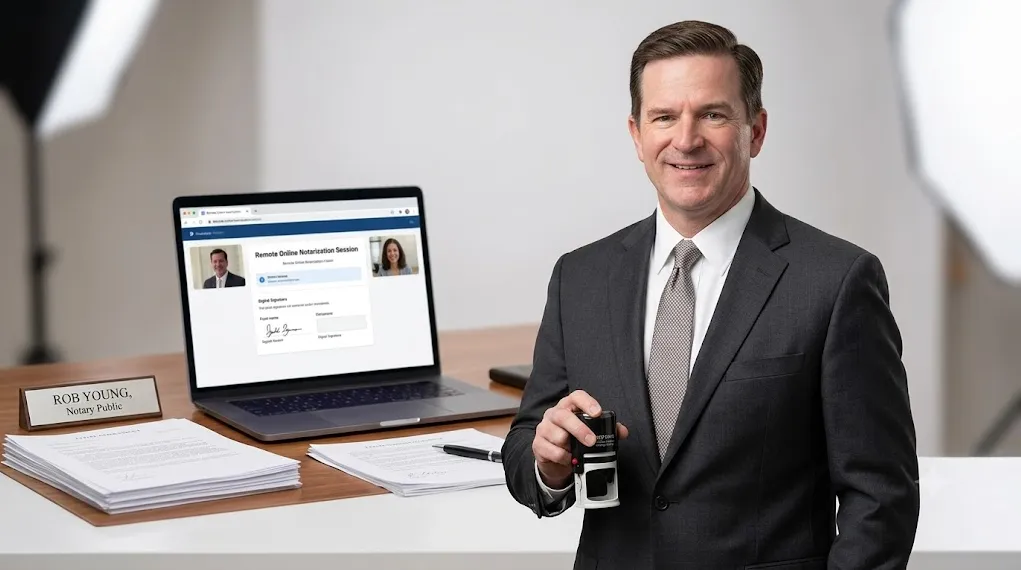
How to Grow a Notary Business Through Relationships and Direct Marketing
How to Grow a Notary Business Through Relationships and Direct Marketing
Having a notary commission and building a notary business are two very different things.
Getting commissioned gives you the ability to perform notarizations within the laws of your state. Building a business means figuring out who needs your services, how you're going to reach those people, how you'll build professional relationships, and how you'll stay visible when the phone isn't ringing.
I recently welcomed Rob Young of Stateline Notary back to the channel for his third interview. Rob is dual commissioned in New York and New Jersey, and since our previous conversations, his business has continued to evolve.
His 2026 numbers are significantly ahead of his previous years, but what I found most interesting wasn't simply that his business grew. It was how it grew. Pasted text
Rob has been expanding his estate planning work, helping attorneys coordinate witnesses, developing professional relationships, changing his marketing strategy, and even becoming a Remote Online Notarization convert after previously being skeptical of RON.
His experience highlights an important lesson for anyone trying to build a notary business: growth doesn't usually come from one source.
Become More Useful to the Professionals You Want to Work With
One area contributing to Rob's growth has been direct estate planning work.
He works with solo attorneys, and he discovered that he could help them even when they didn't necessarily need him to act as the notary.
They still needed witnesses.
Rob built witness teams across three counties in the areas he serves in New York and New Jersey. When an attorney needs witnesses for an appointment, Rob can help coordinate them, even if he isn't performing the notarization himself. Pasted text
That seemingly small service helped him build trust.
Rob described one attorney relationship that developed gradually. There was even a period when the attorney wasn't sending him much work, but he stayed in contact.
Eventually, the relationship reached the point where she trusted him to handle appointments without her being present. They developed a system, Rob knew which pages she needed scanned afterward, and the process became easier for everyone involved. Pasted text
This is a great example of thinking beyond the immediate notarization.
If you're trying to build relationships with attorneys, title companies, or other professionals, ask yourself:
What problem can I remove from their plate?
Sometimes the answer is the notarization itself. Sometimes it's coordinating witnesses, being available for unusual appointments, communicating clearly, or knowing exactly what the client needs after the signing.
Being useful builds trust, and trust can lead to additional work.
Professional Relationships Take Time to Develop
It's easy to approach marketing as a direct exchange.
You introduce yourself today, and you expect an appointment tomorrow.
That's not always how professional referral relationships work.
Rob's experience shows why staying in touch matters. The attorney who now trusts him to handle appointments independently didn't necessarily start there. The relationship developed through repeated interactions and consistent service.
This is particularly important when marketing to professionals who are trusting you with their clients.
They aren't only evaluating whether you can perform a notarization. They're also evaluating whether you'll communicate professionally, handle the client appropriately, follow instructions, and make their job easier.
Sometimes the first assignment is simply an opportunity to prove that you're someone they can rely on.
From RON Skeptic to RON Believer
One of my favorite parts of Rob's journey has been watching his opinion of Remote Online Notarization change.
In our previous interviews, he wasn't exactly RON's biggest fan.
Now, as he put it, he's a convert.
Part of that change came from learning more about the differences between the states where he is commissioned. Rob said he had initially assumed New Jersey's rules were similar to New York's. After conversations with other New Jersey notaries, he went back and researched the applicable rules and realized there were important differences. Pasted text
That opened additional opportunities for his business.
Rob shared a recent example involving a client in Saudi Arabia who needed a document notarized. He received the call with roughly an hour's notice and was able to complete the appointment remotely. Pasted text
RON went from being a very small part of his business to something he now wants to grow.
His experience also reinforces an important point for notaries: never assume another state's laws work like yours.
Always understand the rules that apply to your own commission and the specific notarization you're performing.
RON Rules and Acceptance Can Vary
Rob's experience as a New York and New Jersey notary gives him an interesting perspective because he has to work within two different state frameworks.
During our conversation, he discussed differences he has encountered between the states, including restrictions affecting which documents he can notarize remotely and differences in how RON is being adopted.
He also described differences in how certain real estate documents are being accepted. Pasted text
Because RON laws, document eligibility, and acceptance requirements can change, notaries should verify current requirements through the appropriate state and receiving authority rather than relying on another notary's experience alone.
Rob's own story demonstrates why that matters. His opinion of RON changed after he went back and researched the rules that actually applied to his New Jersey commission.
Experience Isn't Just the Number of Years You've Held a Commission
Rob and I also talked about whether notaries should receive more education before performing notarizations.
We're both big advocates of education.
One reason is that the number of years someone has held a commission doesn't necessarily tell you how much practical experience they have.
Someone might say they've been a notary for 20 years, but that could mean they've maintained a commission for 20 years while rarely performing notarizations.
Rob emphasized that there can be significant nuance in properly performing the role. Notaries need to understand the requirements that apply to them and know how to respond appropriately when unusual situations arise. Pasted text
I've encountered this myself.
Someone may have held a commission for years but never performed an actual notarization. Others may have experience with only one specific type of document.
That becomes especially important with RON because the process may be recorded. If a required step is missed, there can potentially be a record of exactly what happened during the session. Pasted text
Having a commission is one thing.
Knowing how to use it correctly is another.
Stop Thinking of Yourself as "Just a Notary"
Another part of our conversation focused on how notaries value their own work.
Rob regularly encounters people who ask whether being a notary is really his full-time business.
His answer is essentially that there's no such thing as being "just" a notary.
Notaries may be present during major moments in people's lives: buying or selling real estate, executing estate planning documents, dealing with family matters, or handling other important transactions.
As Rob explained, the role may be small within the larger transaction, but that doesn't make it unimportant. Pasted text
I get similar reactions when I tell people I'm a notary.
Sometimes people ask whether that's enough to make a living.
But the word "notary" doesn't describe the entire business model.
There are different client types, industries, services, appointment structures, and professional relationships that can all exist around a notary commission.
The opportunity is often much broader than simply waiting for someone who needs a stamp.
Look Beyond the Most Obvious Notary Niches
Estate planning and real estate are common markets for notaries, but they aren't the only options.
We also discussed family law.
I enjoy working with family law professionals, and I've noticed that some notaries immediately recoil at the idea because they associate the entire field with contentious divorces.
But people dealing with family law still need notarizations.
And family law encompasses more than divorce. Depending on the situation, notaries may encounter documents connected with prenuptial agreements, adoptions, and other major life transitions.
Rob has also started marketing toward family law attorneys as part of his revised strategy. Pasted text
He's moving some of his energy away from networking groups that weren't producing results and putting more effort into direct outreach to attorneys.
That's an important business lesson in itself.
You don't have to keep using a marketing strategy simply because it's what you've always done.
Pay attention to what produces actual relationships and opportunities.
Follow the Work Upstream
When you receive an unusual general notary appointment, don't only think about that one transaction.
Ask where it came from.
Who prepared the document?
What type of professional regularly encounters this situation?
What industry does the client work in?
Could there be more people who need the same service?
One of Rob's recent RON appointments involved an international business situation. Instead of viewing it as an isolated appointment, we discussed how it might point toward another market worth exploring. Pasted text
I often describe this as going upstream.
If one client needs a particular service, look for the professional or business that regularly creates the need for that service.
That's where one appointment can potentially become a recurring source of business.
Social Media Doesn't Have to Generate Instant Sales to Work
Rob has also been putting more effort into social media.
After appearing on several podcasts in 2025, he realized he had a lot of content that wasn't being used. He hired a virtual assistant to repurpose that content into short-form videos.
Eventually, that meant Rob had to start recording more content himself.
At first, he was constantly doing retakes. Over time, talking to the camera became easier. Pasted text
But what's especially useful is how he evaluates the results.
Rob doesn't currently view social media primarily as a direct lead generator.
He views it as visibility.
He has received some inquiries, but his main goal is staying present and top of mind. Pasted text
And I can tell you that strategy works.
When someone asks me for a notary referral in New York or New Jersey, Rob comes to mind because I regularly see him online. I know he's still active, I know what he's working on, and I know I can send someone his way even if he ultimately needs to refer the appointment to another notary. Pasted text
Social media doesn't always need to produce an immediate "I saw your Reel and want to hire you" message.
Sometimes its job is simply to make sure the right person remembers you when an opportunity appears.
Other Notaries Don't Always Have to Be Your Competition
Rob also views other notaries as collaborators rather than simply competitors.
That mindset is something I've learned through my own business too.
When I was newer to the industry, I reached out to someone I considered a direct competitor in my area and asked if I could take her to lunch.
Instead of treating me like competition, she welcomed me.
We still work together and attend networking events together.
Rob has experienced the same collaborative side of the industry. Notaries can send work to one another when an appointment is outside their coverage area, doesn't fit their schedule, or requires someone with different availability. Pasted text
A strong notary network doesn't necessarily take business away from you.
Sometimes it helps you serve more people.
Notaries Are Present During Major Life Moments
Something Rob said during our conversation really captures why this work can matter.
Notaries often meet people during significant moments in their lives.
Sometimes those moments are exciting, such as buying a home or preparing for a marriage.
Sometimes they're difficult.
Rob described being at a hospital bedside with someone preparing for surgery who needed estate planning documents signed. He talked about helping people get their estate plans in order, move through family transitions, and complete important transactions. Pasted text
Those experiences are another reason professionalism and education matter.
To us, it might be another appointment on the calendar.
To the person sitting across from us, it may be one of the most important documents they've dealt with all year.
Will AI Replace Notaries?
We couldn't talk about the future of the industry without talking about AI.
Rob doesn't see AI replacing notaries anytime soon. He does, however, see ways it can assist them.
He pointed to technology involved in Remote Online Notarization, including identity-related analysis and document tools, as areas where automation can potentially support the process.
At the same time, he has encountered tools that still make mistakes. Pasted text
We've both seen similar issues with automated document tagging.
A tool might tag fields for the wrong signer, add unnecessary fields, or miss something that an experienced notary recognizes.
That's why automation shouldn't become a replacement for understanding what you're doing.
AI can be useful.
But a notary still needs the knowledge to recognize when the technology gets something wrong. Pasted text
The Future of RON May Depend on Adoption, Not Just Technology
Looking several years ahead, Rob hopes to see broader RON adoption.
The technology exists, but acceptance isn't necessarily uniform.
He still encounters businesses that prefer traditional pen-and-paper processes. He also described differences he's encountered between New York and New Jersey regarding the acceptance and use of remotely notarized documents. Pasted text
Part of that transition may ultimately be driven by consumers.
People increasingly expect to complete tasks online. The convenience of handling an appointment through a video session rather than coordinating travel can make remote service attractive when it is legally permitted and appropriate for the transaction.
For notaries, that means learning the technology is only one part of the opportunity.
Education may also mean helping potential professional partners understand when and how RON can work for their clients.
Marketing Doesn't Stop Once You Become a Notary
Toward the end of our conversation, we talked about one of the hardest transitions for many new notaries: going from having a commission to thinking like a business owner.
There's a lot more involved than learning how to notarize.
You have to manage client relationships, keep track of repeat customers, decide how you operate, develop systems, and market your services.
And marketing isn't a one-time task.
As I often tell notaries, the clients aren't simply going to come to you. You have to go to the clients.
Rob agreed.
Even established relationships need attention. When business gets quiet, he recommends reaching back out to title companies, signing services, attorneys, and other professional contacts. It doesn't always need to be a sales pitch. Sometimes it's simply staying connected. Pasted text
That consistency is what keeps you top of mind.
Build a Business, Not Just a List of Notarizations
Rob's growth between our interviews wasn't caused by one magic platform, one marketing email, or one perfect niche.
It came from a combination of things.
He strengthened attorney relationships. He solved problems beyond the notarization itself. He built witness teams. He reconsidered RON after learning more about the rules that applied to him. He changed marketing strategies that weren't producing results. He became more active online. He built relationships with other notaries. And he continued educating himself.
That's what building a business often looks like.
You test things.
You learn what works.
You build trust.
You stay visible.
And when something isn't working, you adjust instead of assuming there isn't enough business available.
A notary commission may allow you to perform the service.
Building relationships and consistently marketing that service is what can turn it into a business.


© 2026 Notary SWFL - All Rights Reserved
We are not attorneys and do not provide legal advice or representation.