
Notary Blog
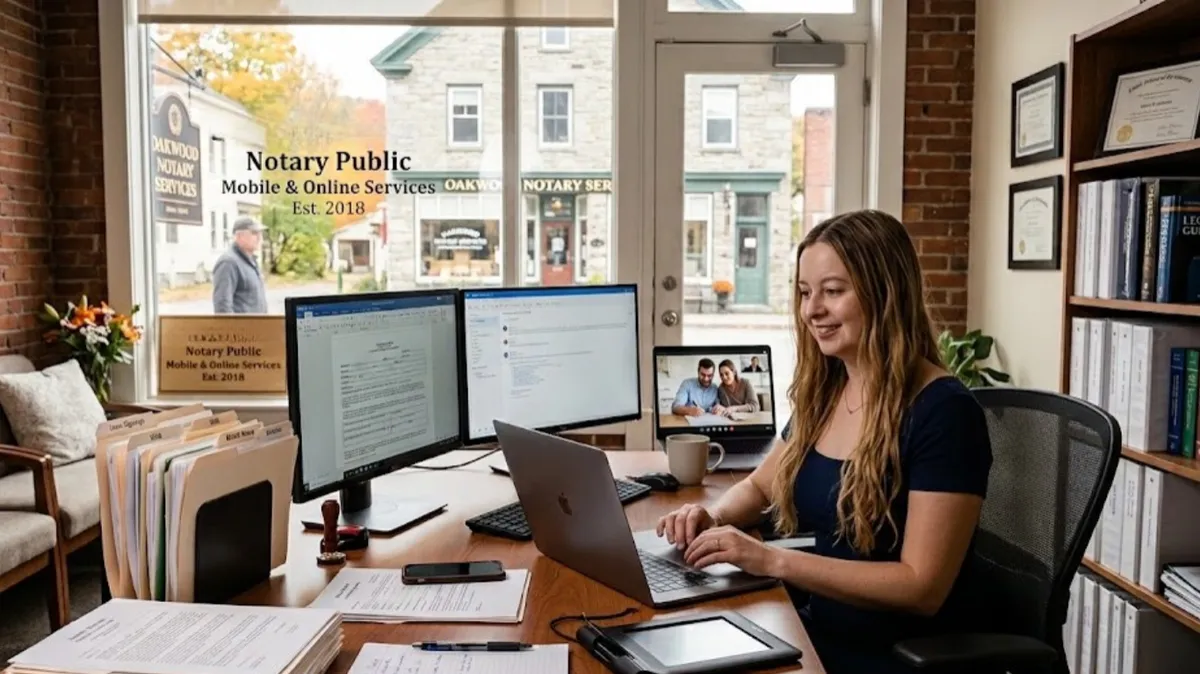
How to Grow a Notary Business Beyond Loan Signings
How to Grow a Notary Business Beyond Loan Signings
When people first enter the notary industry, it can be easy to assume there is one main path to building a business. Maybe that means loan signings, working with title companies, or signing up for platforms and waiting for opportunities.
But there are many ways a notary business can evolve.
I recently sat down with Amanda Moseley, also known online as Your Notary Bestie, to talk about how she has grown her business in a small Oregon community. Amanda started as a mobile notary and eventually expanded into general notary work, wedding officiating, Remote Online Notarization (RON), e-recording, and even scheduling for signing services. Pasted text
Her experience is a great example of something I see often in this industry: you may start with one idea of what your notary business will look like, then discover opportunities you never expected.
Growing a Notary Business in a Small Market
One of Amanda's first challenges was her location.
She lives in a small city and county, so some of the traditional marketing advice she heard during training simply did not fit her market.
When someone tells a new notary to visit 30 title offices or 30 law offices, that strategy assumes those businesses actually exist nearby. Amanda said that when she started, her area had only three title offices.
Instead of repeatedly marketing to the same few businesses, she had to get creative.
She started using local Facebook community groups and expanded her in-person outreach beyond title and law offices. She connected with hospitals, care facilities, in-home caregivers, businesses connected to real estate and insurance, banks, shipping locations, and other places where someone might eventually need a notary. Pasted text
That shift taught her an important lesson: she couldn't build her entire business around title offices.
For notaries in smaller communities, that is an important perspective. The strategy that works for someone in a large metropolitan area may not make sense in your market. Instead of assuming there isn't enough business around you, it may be worth looking at who actually needs your services locally.
General Notary Work Can Be a Business of Its Own
Amanda's business today relies heavily on general notary work rather than primarily on loan signings.
When she does receive loan signing or seller package work, she said it often comes from out-of-state title companies. Locally, she primarily works with direct clients. Pasted text
For Amanda, the economics of general notary work also made sense for her particular market. She explained that Oregon gives her flexibility in how she sets her travel fees, and she has been able to structure those services in a way that works for her business.
This is an important reminder that pricing, allowable fees, and notary rules vary by state. What works for Amanda in Oregon should not automatically be applied to another state.
The broader business lesson, however, applies anywhere: understand all of the work involved when deciding whether an opportunity makes sense for your business.
A signing can involve more than the notarization itself. Depending on the assignment, there may be travel, printing, scanning, shipping, communication, and administrative work involved.
An Unexpected Income Stream: Wedding Officiating
Amanda's business eventually expanded in a direction she hadn't originally planned.
She became a wedding officiant.
At first, she intended to offer simple "sign and go" ceremonies for couples who primarily wanted to complete the legal side of getting married. But she discovered that she loved the work.
Since then, Amanda said she has officiated about 200 weddings, including 79 weddings in 2025 alone. Her services have expanded into larger venue weddings and outdoor adventure elopements. She has joined couples for hikes, waterfall ceremonies, coastal weddings, and even an airboat trip to a private island. Pasted text
Social media has played an interesting role in that part of her business too.
While some couples have contacted her directly through social media, Amanda said some of her strongest connections have been with photographers and other wedding vendors. Those relationships have become a consistent referral source. Pasted text
It's a good example of why networking does not always have to mean marketing directly to the end client. Sometimes the best connection is another professional who regularly works with the same people you want to serve.
Adding Remote Online Notarization to an Existing Business
Amanda had offered Remote Online Notarization for some time, but she wasn't doing it consistently at first.
Part of the challenge was local adoption. She found that many people in her community were more comfortable asking her to come to them in person.
More recently, that has started to change.
Amanda shared that within one month, four people initially contacted her for in-person services. After she provided both the in-person and remote options, they chose remote instead. One of those clients was an attorney who had never tried the process before. Pasted text
Amanda has also been doing more remote work through signing services and for existing clients who happen to be away from the area.
The increased volume has helped with something many newer RONs experience: confidence.
When remote appointments were scattered, Amanda felt like she had to relearn the platform each time. Once she began using it consistently, the process started to feel more familiar. Pasted text
That's an important part of learning almost any new service. Training helps, but repetition can make a huge difference in how comfortable you feel actually delivering it.
How One Client Led to an E-Recording Service
One of the most interesting parts of Amanda's story started with a longtime client.
The client normally used Amanda for in-person notarizations, but Amanda had previously let his wife and assistant know that remote notarization was also available when he was traveling.
Eventually, the client was in Thailand and needed 17 deeds notarized.
Amanda was able to handle the notarizations remotely. The situation then became more complicated when the company needed the documents recorded across multiple counties.
Instead of simply stopping after the notarization, Amanda started researching.
After speaking with a county, she learned about the option to e-record. She passed the information along to the client and initially offered to quote the facilitation service, but the company decided to handle it internally.
A few weeks later, they came back.
They had five more deeds and had been unable to figure out the e-recording process themselves. This time, they asked Amanda for a quote. Pasted text
Amanda researched the recording fees for each county, researched e-recording platforms, and built those costs into her invoice. Because she had never handled a project like this before, she also reached out to someone in her professional network who had experience providing larger white-glove services and used that advice when determining her pricing. Pasted text
Getting approved with an e-recording vendor took longer than Amanda expected, but once she was set up, submitting the deeds became a relatively quick process.
The project also expanded again. When the client later needed additional documents handled while he was several hours away, Amanda connected him with another notary she knew. That notary completed the in-person work and scanned the deeds back to Amanda so she could handle the recording. Pasted text
Amanda walked away with more than revenue from one transaction. She had learned a new process, established a relationship with a new vendor, and gained the confidence to offer another service.
What Amanda Earned From the E-Recording Project
Amanda was also transparent about how she priced this project.
She started with her remote notarization pricing, added the fees charged by the e-recording platform, included reimbursement for the applicable county recording fees, and added her own fee for facilitating the deeds.
Her facilitation fee was $35 per document.
Amanda estimated that her total profit from the project was between $800 and $900, and she was able to complete the work remotely from her laptop. Pasted text
That doesn't mean every notary should immediately add e-recording to their services or expect the same income. Amanda's story reflects one particular client, transaction, market, and set of circumstances.
The more useful takeaway is how the opportunity developed.
She already had a trusted client. A new problem came up. Instead of immediately saying it was outside the scope of her business, she researched whether she could help, sought advice from someone with more experience, learned a new system, and priced the additional work.
Sometimes business growth comes from paying attention when an existing client asks, "Can you do this too?"
Your Local Market May Have Opportunities You Haven't Considered
Amanda has also discovered some extremely location-specific notary work.
Because she lives less than 30 miles from the California border, she receives calls connected to car and RV purchases. She described meeting company representatives and buyers across the state line in Oregon to notarize documents associated with those transactions. Pasted text
It's the kind of opportunity that might never appear in a general "how to start a notary business" course.
That's exactly why learning your own market matters.
The businesses, industries, demographics, geography, and client needs around you can create opportunities that another notary across the country may never encounter.
Growing a Team Without Losing the Client Experience
As Amanda's different businesses grew, another problem appeared: she couldn't personally accept every appointment.
After officiating 79 weddings in 2025, she realized how many days she was unavailable for notary work. She was missing calls and turning away potential signings.
Her solution was to start building a team.
Amanda first brought in her best friend and trained her in general notary work, with plans to expand into loan signings. More recently, she brought her husband into the business to focus on remote signings while he also pursues photography. Pasted text
One system that has helped Amanda manage multiple people is a shared business phone setup. Her team can see client correspondence, while Amanda can leave notes containing details such as dates, times, locations, and pricing.
But technology is only one piece of it.
Amanda emphasized the importance of presenting team members professionally. Instead of awkwardly telling a client that she might be able to find someone else, she confidently explains that someone on her team is available.
Just as importantly, she is careful about who she trusts with her clients.
Her advice is to make sure anyone representing your business treats clients the way you would. A team member becomes an extension of the reputation you've built. Pasted text
What a Signing Service Scheduler Actually Notices About Notaries
Amanda has another perspective that most notaries don't get to see: she works part time as a scheduler for two signing services.
Her role includes scheduling notaries, reviewing scans and tracking information, and communicating with title companies and other members of the team.
Working behind the scenes has shown her what notaries do that makes a positive impression, as well as what creates problems. Pasted text
One of the biggest factors is surprisingly simple: communication.
Amanda has seen notaries ignore messages until shortly before an appointment. On the other hand, she notices notaries who communicate clearly, keep documents organized, and provide clean scans.
Those details matter when signing services decide who they want to work with again.
In Amanda's experience, strong communication can contribute to a notary being added to a preferred list. Pasted text
Should You Follow Up With a Signing Service?
Amanda and I also talked about something very simple that notaries can easily overlook: following up after an assignment.
From Amanda's experience as a scheduler, relatively few notaries reach back out afterward to say thank you.
A follow-up alone won't compensate for poor work. Amanda made that very clear.
But if the signing went well, the scans were good, and the notary communicated throughout the process, a thoughtful follow-up can remind a busy scheduler to go back, leave a review, or mark that notary as preferred. Pasted text
It's not about sending a message just to get another job. It's about combining good service with good professional communication.
Building a $9,000 Month in a Small Town
Amanda's best month at the time of our conversation was May, when her businesses generated around $9,000.
But I appreciated the way she talked about that number.
She didn't present it as a promise or benchmark that every notary should reach. Instead, she pointed out that she lives in a smaller area where her expenses may be very different from those of someone operating in a larger city. Pasted text
Income can also fluctuate.
Marketing, workload, capacity, seasonal changes, expenses, and the amount of business you can actually fulfill all affect the final numbers. One strong month doesn't mean every month will look the same.
That's an important perspective in an industry where income screenshots and revenue numbers can easily become the focus.
Revenue tells only part of the story.
There Isn't Just One Way to Build a Notary Business
One of my favorite things about interviewing other notaries is seeing how differently their businesses evolve.
Amanda didn't build her business around one service. She adapted to her local market and followed opportunities as they appeared.
General notary work led to direct clients. Wedding officiating became a major part of her business. RON created another way to serve existing clients. One complicated client request introduced her to e-recording. Building a team helped her accept work when she wasn't personally available. Scheduling for signing services gave her an entirely different view of what makes a notary stand out.
That's the bigger lesson from Amanda's story.
Your notary business doesn't have to look exactly like someone else's.
Pay attention to your market. Listen to what your clients are asking for. Build relationships with other professionals. Learn new services carefully when they make sense for your business, and don't be afraid to adjust when the original plan doesn't fit your reality.
Sometimes the next opportunity isn't another version of what you're already doing.
It's something you didn't know belonged in your business yet.


© 2026 Notary SWFL - All Rights Reserved
We are not attorneys and do not provide legal advice or representation.